
Minimally Invasive Tension-free Hernia repair with smaller scars, less pain, and a quicker return to daily life?
Laparoscopic Hernia Surgery Specialist in Navi Mumbai
- Dr Nitish Jhawar, with 26 years of experience
Book An Appointment
Dr. Nitish Jhawar, a senior laparoscopic hernia surgery specialist in Navi Mumbai, with over 26 years of experience in tension free hernia repairs with minimum recurrence rates.
He specialises in TEP (Totally Extraperitoneal) and TAPP (Transabdominal Preperitoneal) techniques for inguinal, umbilical, and incisional hernias.
Utilizing 4K high-definition imaging, laparoscopic system and the latest 3D mesh technology, we ensure a repair that is strong, aesthetic, and allows for a rapid return to your daily life.
A hernia rarely improves on its own and often requires surgical intervention to prevent complications like strangulation. A successful outcome depends on the surgeon’s ability to reinforce the abdominal wall without damaging surrounding nerves.
What Are The Treatment Options for Hernia Operation in Navi Mumbai?
In modern surgical practice, hernias are no longer treated with large, painful incisions.
Read about Hernia Treatment in Navi Mumbai
Dr. Nitish Jhawar specializes in two high-precision, minimally invasive pathways for treating hernias are Laparoscopic Hernia Surgery and Robot-Assisted Hernia Surgery.
Both methods offer faster recovery times, reduced pain, and minimal scarring compared to traditional open surgery.
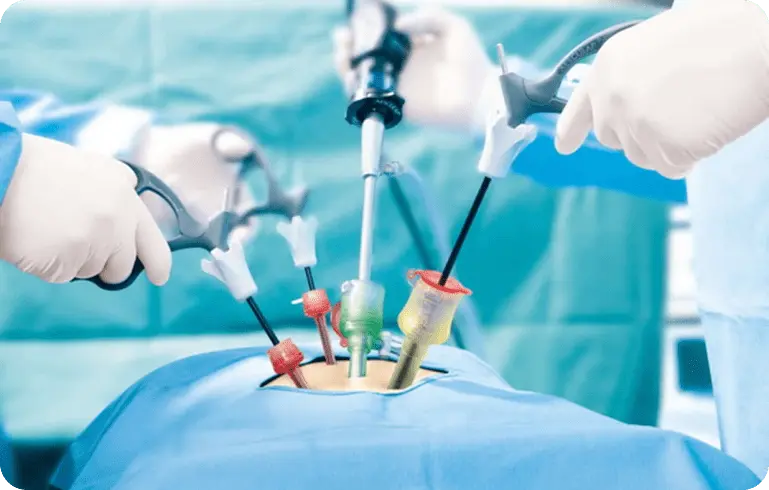
- Laparoscopic Hernia Surgery (Keyhole): The gold standard to repair the hernia. Using 3 tiny ports (5mm to 10mm), Dr. Jhawar reinforces the abdominal wall from the inside.
- Robotic-Assisted Hernia Surgery: Reserved for carefully selected cases specially complex, recurrent, or multi-defect hernias. This offers 360-degree precision and 3D visualization.
Benefit of Laparoscopic Hernia Surgery
Laparoscopic Hernia Surgery is a minimally invasive technique for treating hernias.
Laparoscopic surgery uses only a few small cuts.
Compared to open surgery, patients typically experience less pain and a faster recovery after laparoscopic hernia surgery.
- Less Post-Operative Pain: The smaller incisions used in laparoscopic surgery cause less trauma to the surrounding tissues, resulting in reduced pain during recovery.
- Faster Recovery: Patients typically experience quicker recovery times than open surgery, allowing them to return to normal activities sooner.
- Minimal Scarring: Since the incisions are much smaller, laparoscopic surgery results in less visible scarring, which is both aesthetically pleasing and beneficial for healing.
Laparoscopic Hernia Surgery in Navi Mumbai: Procedure
How we Ensure Tension free hernia Repair
Dr. Nitish Jhawar, Senior Laparoscopic & Robotic Surgeon, performs hernia surgeries at premier facilities like Apollo Hospital, Belapur, following a strict safety protocol.
Pre-Surgery Hernia Evaluation
Before the surgery, Dr. Nitish conducts a thorough assessment, including physical exams and high-definition imaging, to confirm the hernia type (Inguinal, Umbilical, or Incisional) and severity.
Choosing the Right Technique: TEP vs. TAPP vs TEP Hernia Repair
TEP (Totally Extraperitoneal): For groin hernias we often use TEP, where the repair is done outside the abdominal cavity, which significantly reduces post-op bloating.
TAPP (Transabdominal Preperitoneal): Best for complex or bilateral hernias, allowing for a full internal inspection of the abdominal wall.
keyhole Hernia Surgery with 4K HD Visualization and 3-D Mesh
Anaesthesia:
The surgery is usually performed under general anaesthesia.
Small Incisions:
Dr. Nitish makes 3 to 4 small incisions (typically around the belly button area) rather than one large cut, which is used in traditional open surgery.
Insertion of the Laparoscope:
A thin tube with a camera, a laparoscope is inserted through one of the small incisions. The laparoscope transmits live images to a monitor, giving the surgeon a clear, magnified view of the hernia and surrounding tissues.
Minimally Invasive Hernia Repair:
Through the other small incisions, the surgeon inserts specialized surgical instruments. Using these tools, the herniated tissue is carefully pushed back into place, and a mesh may be placed over the weakened area to reinforce the abdominal wall and prevent recurrence.
3-D Mesh Reinforcement:
We use lightweight, biocompatible 3D meshes over the weakened area to reinforce the abdominal wall ensuring a "tension-free" closure that minimizes the risk of the hernia returning.
Closing the Incisions:
Once the hernia is repaired, the small incisions are closed with stitches or surgical glue, leaving minimal scarring.
Dr. Nitish Jhawar is one of the best Laparoscopic hernia surgeons in Navi Mumbai who uses state-of-the-art techniques to ensure minimal discomfort, quick recovery, and long-lasting results.
What Our Patients Say
Fast and Pain free Recovery: Hernia Surgery at Apollo Hospital
Because Dr. Nitish Jhawar uses Advanced Laparoscopic (Keyhole) techniques, your recovery is significantly faster than traditional open surgery.
Below is what you can expect as you return to your normal routine:
Immediate Post-Surgery Recovery
Hospital Stay:
Most laparoscopic procedures are Daycare surgeries, meaning you are admitted in the morning and discharged the same evening. For complex cases, a short overnight stay at Apollo Hospital ensures maximum safety.
Waking from Anaesthesia:
You will recover in a monitored setting as the anesthesia wears off. Mild grogginess is normal and temporary.
Pain Management:
Mild discomfort or pain is expected around the incision sites. The surgeon will prescribe pain medications to manage any discomfort during the first few days.
Activity Restrictions
First Few Days:
Rest is encouraged for the first 24–48 hours. Light activities like walking around the house are recommended to help with circulation and prevent blood clots.
Avoid Straining:
Avoid lifting heavy objects, bending over, or straining for at least 2 to 4 weeks to allow the repaired tissue to heal properly, properly and to ensure the 3D mesh integrates perfectly
Returning to Normal Activities and Work:
Most patients can return to light activities, light driving, or desk jobs within a week or two. They should avoid more strenuous physical activities and exercise for 4 to 6 weeks.
Pain and Discomfort
Mild Pain:
It's normal to experience mild to moderate pain around the incision site for a few days post-surgery. This pain typically subsides within a week and is well-managed with prescribed painkillers.
Swelling and Bruising:
Some swelling and bruising around the incision areas are common. This will gradually disappear over the first week or two.
Laparoscopy Wound Care
Incision Sites:
We use dissolvable stitches or surgical glue—meaning no painful stitch removal is needed. Simply keep the area clean and dry.
Follow-Up Care:
A personal follow-up visit with Dr. Jhawar is scheduled within 7–10 days to monitor your healing progress and clear you for increased physical activity.
Diet after Laparoscopic Surgery
Light Diet:
After surgery, patients are encouraged to start with a light high fiber diet and gradually return to their normal eating habits. It’s common to experience mild digestive issues, such as bloating or constipation.
Staying Hydrated:
Drinking plenty of fluids and eating fibre-rich foods can help prevent constipation, a common issue after surgery due to pain medications and reduced activity.
Watch for Complications
Signs of Infection:
While infections are rare, watch for signs such as increased redness, swelling, or drainage from the incision sites, fever, or worsening pain.
Hernia Recurrence:
Although rare, hernia recurrence is possible, particularly if post-operative care instructions (such as avoiding heavy lifting) aren’t followed.
Full Recovery Timeline
- Day 1-2: You are encouraged to walk.
- Weeks 1–2: Most patients feel 90% recovered and resume nearly all “normal life” activities.
- Week 6: Complete internal healing is achieved, allowing for a return to heavy gym workouts, sports, and heavy lifting (>5kg).
Dr. Nitish will personally clear you for full activity during your follow-up.
Why Choose Dr. Nitish Jhawar: Hernia Surgeon Navi Mumbai
Dr. Nitish Jhawar is a highly experienced laparoscopic hernia surgeon in Navi Mumbai with specialized training in both laparoscopic and robot-assisted hernia surgeries.
- Experience: 26+ years and thousands of successful laparoscopic procedures.
- Technology: Access to 4K Laparoscopy and the da Vinci Robotic platform at Apollo Hospital.
- Results: One of the lowest recurrence rates in Navi Mumbai due to specialized mesh placement techniques.
Frequently Asked Questions (FAQs)
Both are minimally invasive procedures, but laparoscopic surgery uses a camera and traditional instruments, while robotic-assisted surgery involves robotic arms controlled by the surgeon. Robotic surgery offers greater precision and 3D visualization, making it ideal for complex cases.
Laparoscopic surgery involves 90% smaller incisions, resulting in less trauma to the muscles, significantly lower pain levels, and a near-invisible scar compared to the 10-15 cm cut of open surgery.
No. We use modern “lightweight” meshes that integrate with your natural tissue. Most patients forget the mesh is even there within a few weeks.
Recovery from both laparoscopic and robotic-assisted hernia surgery typically takes 1 to 2 weeks for light activities and 4 to 6 weeks for full recovery, including heavy lifting or strenuous exercise.
Most patients can return to desk jobs within 1 to 2 weeks. However, for physically demanding jobs, it may take up to 4 to 6 weeks before returning to full activity. Always follow your surgeon’s advice.
Get all your questions answered and experience a smooth recovery with our expert hernia care.
Dr. Nitish Jhawar performs robotic-assisted procedures at Apollo Hospital, Belapur. Book an Appointment with a Hernia Specialist in Navi Mumbai.