
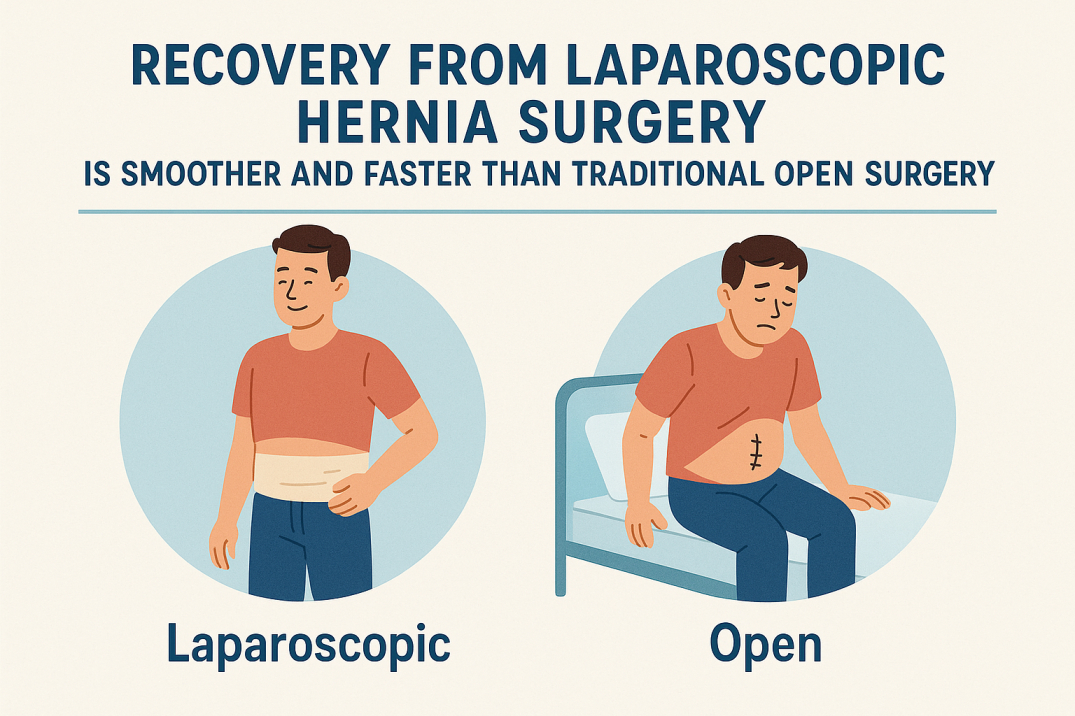
Recovery from laparoscopic hernia surgery is smoother and faster than traditional open surgery. Most people walk home the same day, resume light activities within a few days, and return to their routine with very little discomfort.
However, understanding what to expect after surgery and how to care for yourself during recovery plays a vital role in achieving the best possible outcome.
In this blog, we’ll explore the recovery process after laparoscopic hernia surgery, how to care for yourself at home, and the important choices that make recovery easier.
These insights come from what Dr Nitish Jhawar has seen over years of treating patients at Neoalta Clinic, Vashi and Apollo Hospital, Navi Mumbai.
A hernia happens when an internal organ or tissue pushes through a weak spot in the abdominal wall, something you may notice as a bulge or swelling, often with discomfort while coughing or lifting.
In the laparoscopic hernia repair, instead of a large cut, we make a few tiny incisions through which a laparoscope (attached with camera) and fine surgical instruments are passed.
The camera gives a magnified, high-definition view of the hernia on a monitor, allowing for extremely precise repair, often with better visualization than what we get in open surgery.
The muscle gap of hernia defect is reinforced using a surgical mesh, and because the tissues around the area are handled gently, there’s much less pain, almost invisible scars, and a faster return to your routine.
For most patients, this minimally invasive technique feels less intimidating once they understand how controlled and accurate the process is. In fact, many are surprised at how quickly they recover walking within hours and getting back to work in just a few days.
If you’d like to know how laparoscopic hernia repair compares with traditional open surgery, you can read another post: Advantages of Laparoscopic Hernia Repair.
Soon after laparoscopic hernia surgery, you’ll rest for a while in the recovery area as the anaesthesia wears off. Most patients feel alert and comfortable within a short time, often ready to go home the same day.
It’s normal to have mild soreness near the operated area or a feeling of fullness in the abdomen. Some patients also experience a dull ache in the shoulder; this is from the harmless gas used during surgery to create working space inside the abdomen.
Pain killers are usually prescribed to help with this and this usually settles within a couple of days.
Your surgeon will give clear instructions regarding wound care, activities to avoid and medications.
After laparoscopic hernia surgery, Dr Nitish Jhawar does not recommend total bed rest. Patient is encouraged to start walking on day one of surgery. Give your body the rest it deserves but avoid over resting.
Every patient heals at a slightly different pace depending on the type of hernia, other health conditions, and how carefully post-surgery advice is followed. Most people find that recovery after laparoscopic hernia surgery is much faster than they expected.
Here’s a general guide to help you understand what to expect:
Pain: There may be mild to moderate pain in the first 48–72 hours after hernia surgery. You. Use prescribed analgesics, cold packs, and light compression.
Diet: Stick to light, high-fiber foods like fruits, dal, oats this prevent easy bowel movements and no strain while passing stool. Your surgeon will advise mild stool softeners like psyllium (Isabgol).
Walk: It is better to start walking within 6–12 hours post-op, short walks every few hours help circulation, prevent clotting and aid digestion. Avoid bending or lifting.
Dressing: Keep the dressing clean and dry. Doctor will usually check the dressing and change it before your discharge.
Majority of patients are discharged 2nd day of laparoscopic hernia surgery and you will get clear instructions on how to take care of tiny cut at operation site and list of medication to take.
Walk and Activities: At home patients are encouraged to move around the room to help improve blood flow and healing. You can gradually increase the walk as per your fitness, more you keep active, better you will feel.
Avoid lifting, bending, or sudden twisting. You can do daily chores like brushing your teeth etc
Pain should significantly reduce. Move more comfortably, walk longer, and manage without regular pain meds.
Pain: By now, soreness and pain usually fade and pain killers are no longer required.
Daily Activities: Many patients feel ready to return to desk work by second week. You can increase your walk distance and start gentle exercises with your hernia surgeon’s approval. If anything causes strain in your abdomen, it’s too soon.
By Day 10–14 you can resume light chores, washing dishes, cooking. No heavy lifting (under 5 kg) until further advised.
Driving: Avoid driving until pain settles (usually after 10 days), and you feel confident.
Exercise
After 3 weeks of hernia surgery, usually, you can start low impact workouts such as stationary biking, or yoga. Hevey exercises like sit ups and leg lifts are to be avoided.
Same way heavy weight lifting more than 5 kg is to be avoided.
By this time, most po-op hernia patients are back to normal, full recovery is archived. Most patient can do moderate workouts and start driving.
By Week 6, most individuals can resume full physical exercise, moderate weightlifting, and regular work routines. However, this needs fitness from your hernia surgeon.
Internal healing after laparoscopic hernia surgery happens gradually and proper post op care help in better recovery, Watch for any return of bulge, pain, or digestive changes. These may indicate mesh issues or strain. Maintain weight control, core workouts, and proper posture to prevent recurrence
To learn more about safe movements post-surgery, visit our Exercise After Hernia Repair guide for expert-approved recovery workouts.
Recovering well after laparoscopic hernia surgery is about doing the right things at the right time.
Here are some simple recovery tips recommended by Dr Nitish Jhawar
Healing after hernia repair is different for everyone. Follow your surgeon instruction about rest, activities, diet and medications, as he knows what is best for your hernia recovery.
Surgeons usually recommend light walking from surgery day, once you feel comfortable. This is better for circulation and healing as well as to prevent complications.
If your work doesn’t involve heavy physical strain, you can usually resume light activities within a few days. Being active but not over straining is the best to help your hernia recovery. Be careful to not put any strain on the abdomen, you can wear abdomen binders also.
High fibre diet with fruits, vegetables, prevent constipation, which is common cause of discomfort after hernia surgery. Drinking plenty of water and eating healthy diet helps in better bowel movement.
Keep the operated area clean to prevent from infection and promote healing. Wear loose, comfortable, soft cotton clothing as tight clothing may rub against the operation area.
Nicotine and alcohol can slow the process of healing. Toxin free state helps your hernia heal faster.
Following these directions helps prevent infection, ensures smooth recovery and prevent hernia recurrence.
Pain after laparoscopic hernia surgery is usually mild and it can be managed with the pain medicines. Take analgesics as advised by your surgeon as being pain free helps in your activities. It works better if you take the medicines before pain appears.
Pls ask your hernia surgeon before taking any over-the-counter pain relievers. You can use an ice pack intermittently during the first few days to minimize swelling and tenderness.
When to call your doctor
If you notice any redness, swelling or discharge from the operation wound, or experience severe pain, please contact your operating surgeon.
Choosing the right expert for laparoscopic hernia surgery is important for the best outcome and smooth recovery. An experienced surgeon ensures that hernia is repaired properly which is important for faster healing and reduced risk of hernia recurrence.
If you’re considering laparoscopic hernia surgery, visit our Contact Us page to schedule a consultation with Dr Nitish Jhawar.
Recovery after laparoscopic hernia repair is typically smooth for most patients. There is less pain, quicker recovery, early return to work and minimal scars. Care after the surgery, like gentle movement, balanced food, rest, and follow-up improves recovery.
When patients receive the right guidance, they can take better care for better post op experience.
Ready to take the next step? Schedule a consultation today and discover how minimally invasive laparoscopic hernia surgery can help you heal faster and live pain-free.
Dr. Nitish Jhawar, Senior Laparoscopic and Colorectal Surgeon, has 25 years of experience and offers laparoscopic and robotic hernia repair at Apollo Hospital, Belapur and Neoalta Clinic, Vashi, Navi Mumbai.
You can also explore Recovery after Robotic Hernia Repair by Dr Nitish Jhawar